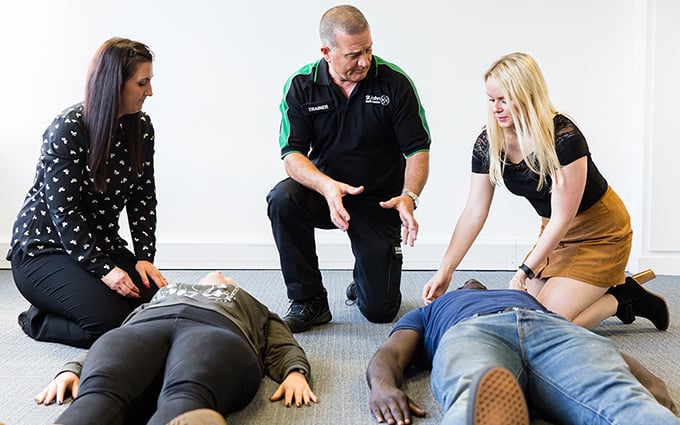
To carry out the primary survey:
- Check for Danger.
- Check for a Response.
- Open Airway.
- Check Breathing.
- Check Circulation.
- Treat the steps as needed.
The primary survey is a quick way to find out how to treat any life-threatening conditions a casualty may have in order of priority. We can use DR ABC to do this: Danger, Response, Airway, Breathing and Circulation.

Danger. Before approaching the casualty, always make sure the area is safe.

Response. Check if the casualty is responsive or unresponsive. As you approach them, introduce yourself and ask them questions to see if you can get a response. Kneel next to their chest and gently shake their shoulders, asking, ‘Are you OK?’, ‘Can you open your eyes?’.

Airway. Next, you need to check that the airway is open and clear. Open the airway by placing one hand on the forehead to tilt the head back and use two fingers from the other hand to lift the chin.

Breathing. You now need to check if the casualty is breathing normally. Keep the airway held open, place your ear above their mouth and look down at their chest. Listen for sounds of breathing and see if you can feel their breath on your cheek. Watch to see if their chest moves. Do this for no more than 10 seconds.
Please note:
During the first minutes of cardiac arrest, about half of casualties will do something called 'agonal gasping'. They can open their mouths, extend their neck, and take usually slow, sometimes noisy gasps. This is not normal breathing and, in a patient with no signs of life, is a sign of cardiac arrest.

Circulation. Once you have established that they are breathing normally, look and check for any signs of severe bleeding.
Once you have completed your primary survey and treated any life-threatening conditions, you can move on to the secondary survey (top-to-toe survey).

For more information on what you need to know when buying and installing a defibrillator, from costs to training and storage, read our Defibrillator guide for first time buyers.
Enter your email address below and we will send you instructions on how to create a new password.
Your email address is registered on our Major Accounts portal – to receive your agreed pricing for training courses please proceed to the portal.